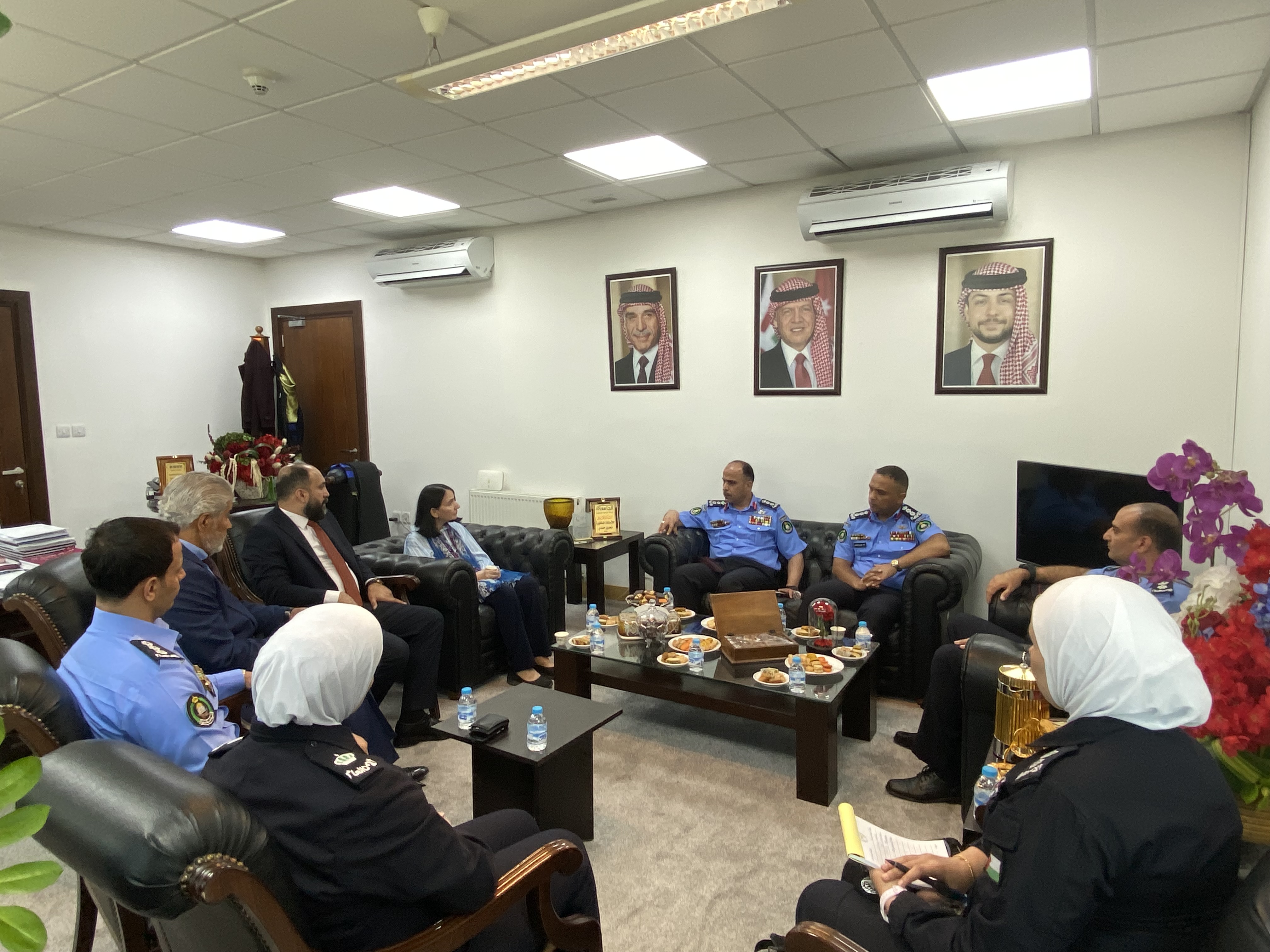
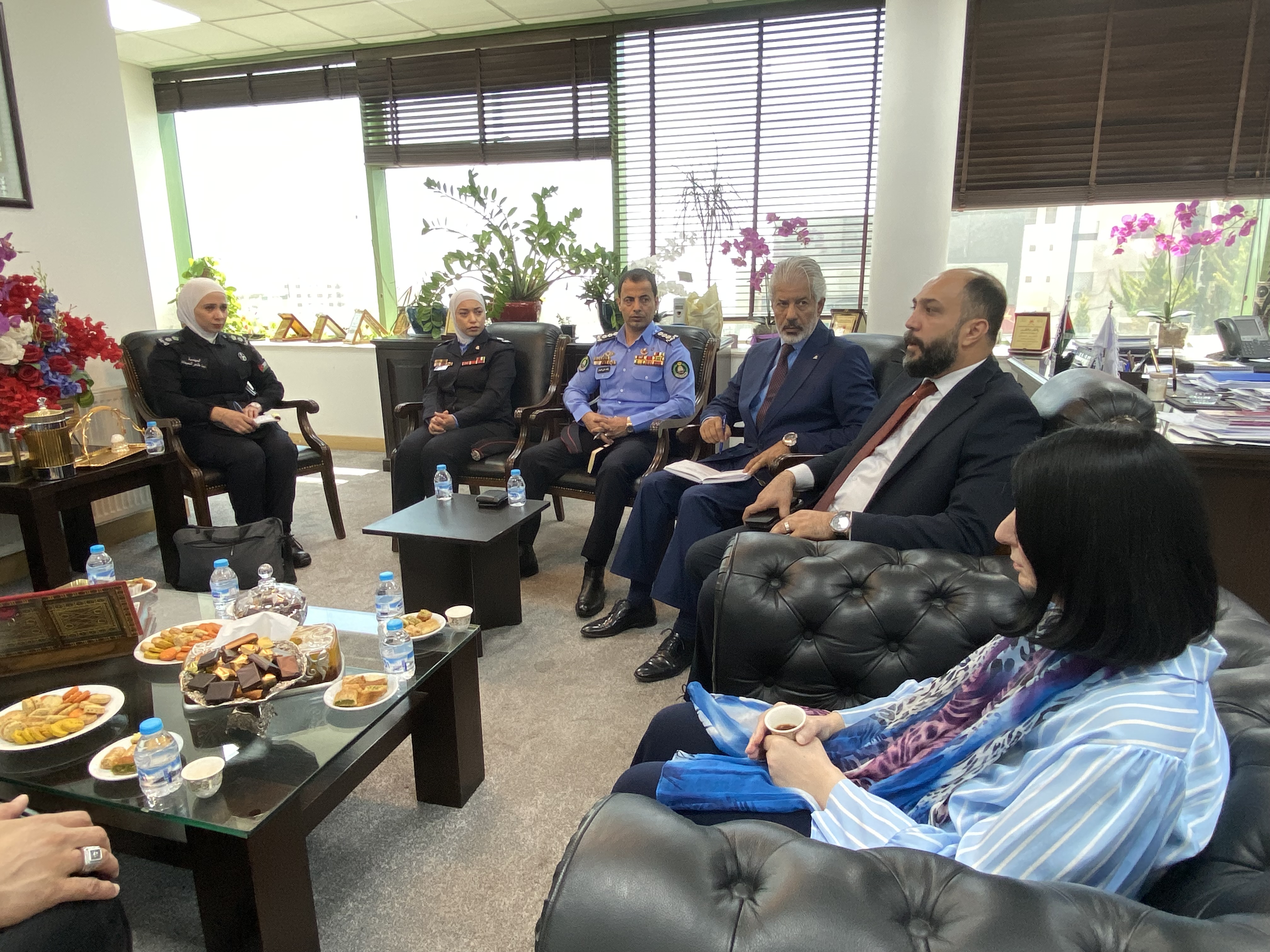
Professor Dr. Tahreer Hamdi, Director of the Arab Open University – Jordan, received in her office a delegation from the Public Security Directorate, headed by Colonel Dr. Ahmad Al-Khalidi, Commander of the Royal Police College, and Colonel Khaled Al-Abbadi, Head of the College of Security Sciences, accompanied by their respective delegation members.
The meeting was also attended by Dr. Anas Ghazalat, Assistant Director of the University for Administrative and Financial Affairs, and Dr. Faisal Al-Sarhan, Dean of the Faculty of Media and Communication.
Dr. Faisal welcomed the visiting delegation and expressed his appreciation and gratitude to the Public Security Directorate for the visit, which contributes to strengthening cooperation and communication between the two sides. Colonel Al-Khalidi, Commander of the Royal Police College, in turn, expressed his appreciation for the warm reception, emphasizing the importance of strengthening the partnership between the two institutions in relevant and pressing areas of mutual interest.
The meeting addressed a number of areas of mutual interest. Professor Dr. Tahreer Hamdi, Director of the University, Dr. Anas Ghazalat, Assistant Director for Administrative and Financial Affairs, Dr. Faisal Al-Sarhan, Dean of the Faculty of Media and Communication, Colonel Al-Khalidi, Commander of the Royal Police College, Colonel Al-Abbadi, Head of the College of Security Sciences, and the accompanying delegation members emphasized the importance of continuing cooperation and coordination among the Royal Police College, the Academy, and the Arab Open University. They also highlighted the importance of benefiting from the academic and training expertise and resources available at the University in ways that contribute to developing the skills and capabilities of personnel of the Public Security Directorate.
The two sides also agreed to move forward with enhancing cooperation in the delivery of training programs, workshops, and specialized seminars. Areas of cooperation include artificial intelligence, given its growing importance and significant role in advancing institutional and security operations, as well as exploring its latest applications and uses. Cooperation will also extend to cybersecurity, including raising awareness of cyber risks, developing appropriate methods for addressing them, and mitigating their impact on institutions.
The meeting further explored potential cooperation in accounting and administrative sciences, with the aim of enhancing employees' skills in financial and administrative areas, improving the efficiency of administrative and oversight practices, and strengthening institutional performance. Cooperation in media and communication was also discussed, including leveraging academic expertise to develop institutional and media communication skills and improve the management of communication messages.
Another important area discussed was the possibility of offering a specialized course on risk and threat management and identification within various institutions. This would involve benefiting from specialized scientific methodologies, including the Boston methodology, to enhance risk analysis, identify potential threats, assess their impact, and develop appropriate mechanisms for addressing them and minimizing their effects on institutional performance and business continuity, while also assessing the return on investment associated with such measures.
At the conclusion of the meeting, both sides emphasized the importance of maintaining continuous communication and coordination and working to translate the areas of cooperation discussed into practical training programs, lectures, and workshops that can be implemented effectively. Such initiatives are expected to deliver mutual benefits while contributing to the development of professional competencies and institutional capabilities.